The persecution remembered in stories of early Christians thrown to the lions involved more than disagreement over private beliefs. In some documented cases, Roman officials treated refusal to honor the gods and the emperor’s image as grounds for punishment. For Christians, that refusal expressed allegiance to Jesus.
That distinction matters. If you miss the clash between Jesus’ Kingdom and Rome’s order, martyrdom becomes a grim story instead of a warning about visible discipleship.
Watch for what history makes plain:
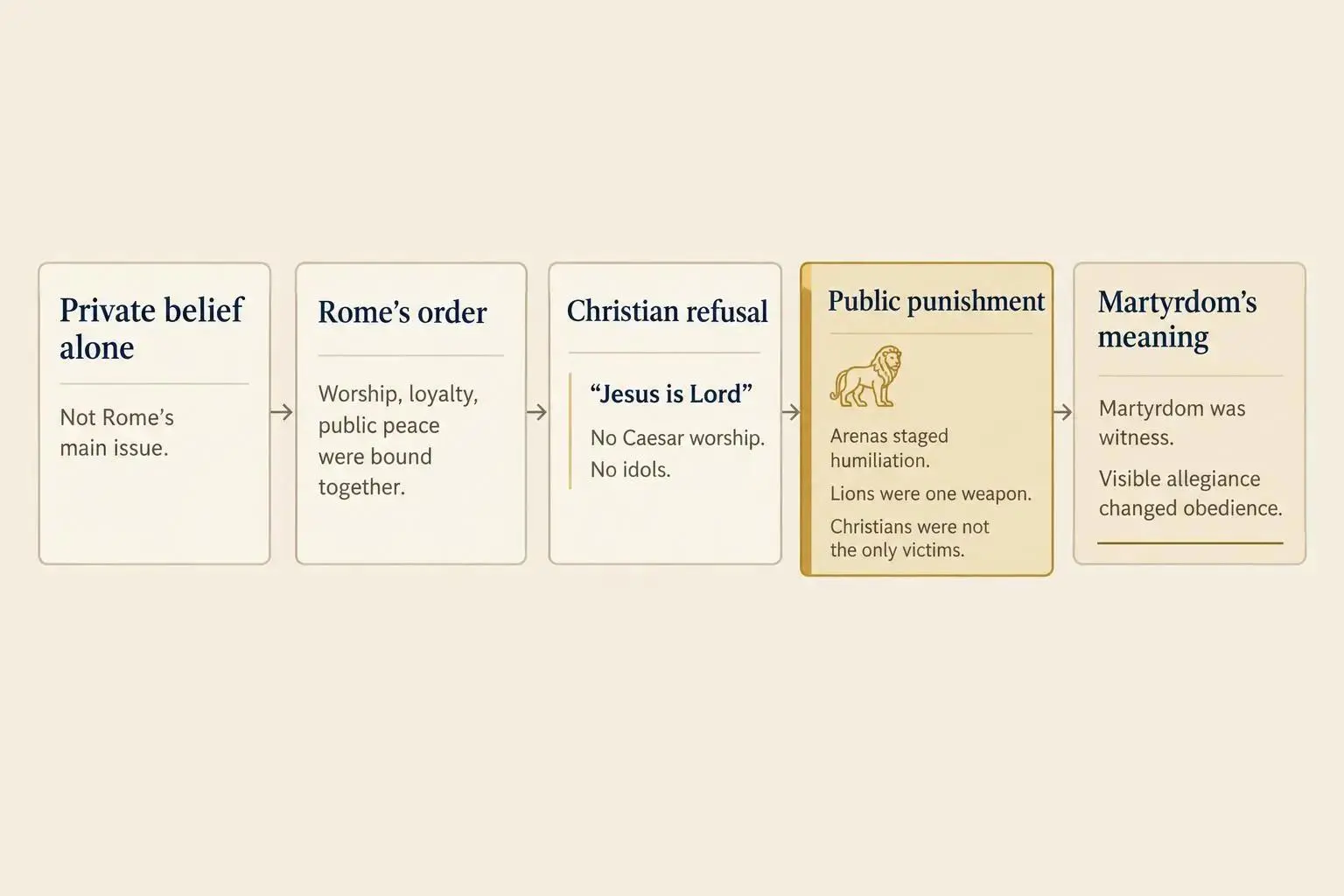
- Lions were one weapon in public spectacles meant to humiliate and frighten.
- Christians were not the only victims, but their refusal to compromise made their deaths a witness.
- Real allegiance to Jesus changes what you obey.
Read it clearly. Let it search you.
The Short Answer
When people talk about early Christians thrown to the lions, they’re reaching for a real thing, but usually in a flattened way.
Early Christians were not mainly targeted because Rome couldn’t tolerate unusual spiritual ideas in private. Rome had room for many gods, many rituals, and a fair amount of religious mixing. The trouble started when Christians refused to treat Jesus as one more option in the pile. They confessed Him as Lord. In the Roman world, that was not a small religious preference. It touched loyalty, worship, public life, and power.
Some believers were killed by wild animals in public arenas. Those deaths were meant to terrify the crowd and warn anyone tempted to follow the same path. So yes, the phrase points to real Roman persecution of Christians. But if we stop at “Rome was cruel,” we miss the harder truth. For Christian readers, their witness shows how faith could become visible and costly; it does not explain every persecution in the same way.
What People Mean by “Thrown to the Lions”
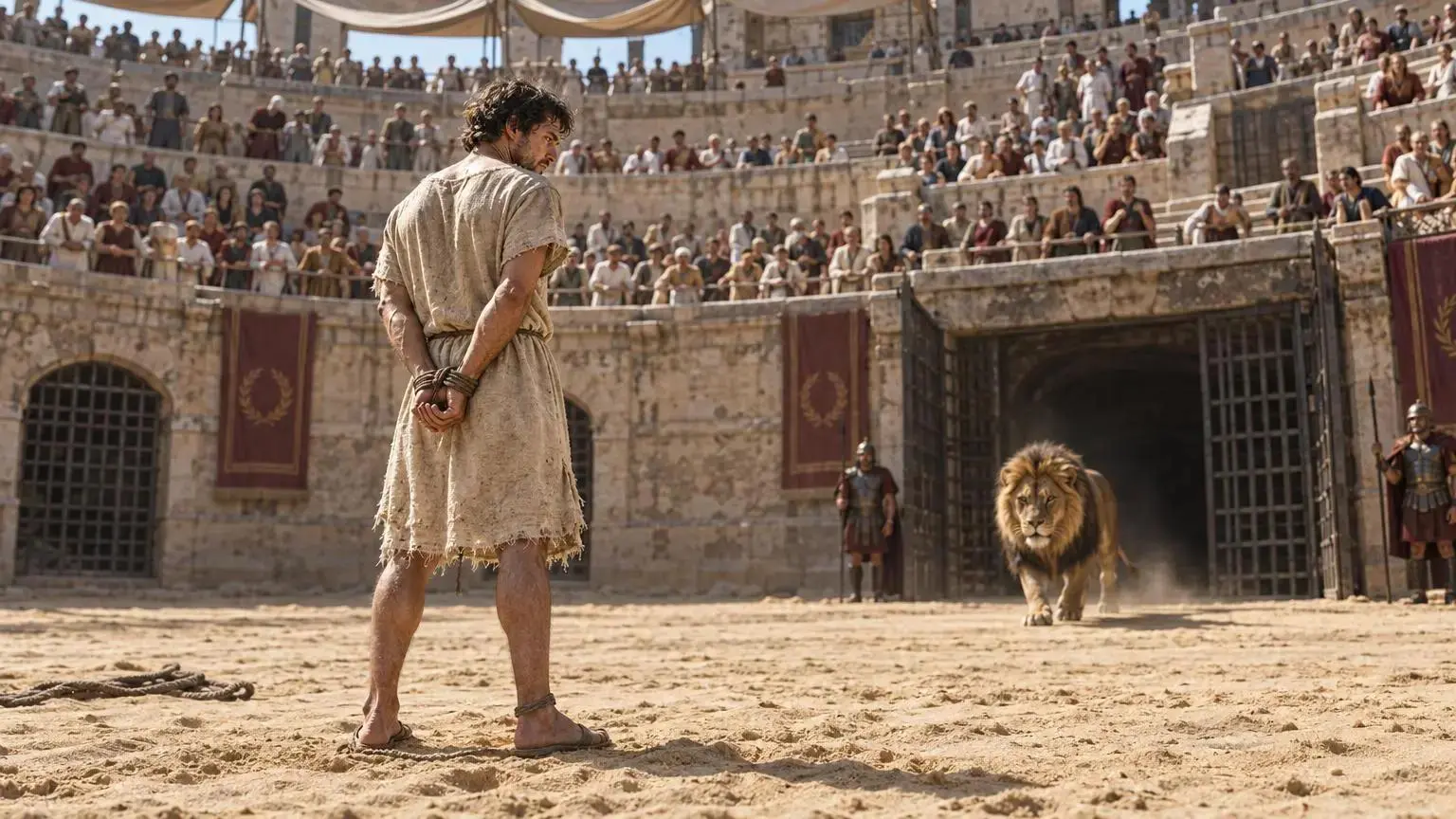
The phrase usually refers to public executions in Roman arenas where condemned people could be exposed to wild beasts as part of staged shows. Lions are the image people remember, but the larger system mattered just as much as the animal.
In Christian memory, “thrown to the lions” became shorthand for the suffering of the church under Rome. That shorthand helps, but it also blurs things. Not every persecuted Christian died that way. Some were imprisoned, beaten, burned, beheaded, or pressured to renounce Christ through public sacrifice.
Arenas were built for more than sport. They were places where Rome displayed control with brutal clarity.
The history of lions in Rome belongs to a wider machine:
- imported animals from across the empire
- trained spectacles for crowds hungry for blood and novelty
- public punishments staged as entertainment
- state power dressed up as civic life
That last part matters. Execution was not hidden away in a back room. It was dragged into the center, timed for effect, and watched by spectators.
So when we say early Christians thrown to the lions, we should keep two truths together. First, some Christians really did face death by wild beasts. Second, the deeper wound was not just physical death. It was public humiliation, terror, and the message sent to everyone watching: this is what happens to people who will not bend.
Why Christians Looked Dangerous in Ancient Rome
To modern ears, it can sound strange that a small religious minority could look threatening. But Rome did not treat religion as a private hobby. Worship, public order, civic peace, and political loyalty were woven together.
If the city honored its gods, the city expected favor. If the emperor received proper respect, the social order held. That was the logic. Christians stepped right into the middle of that and said no.
They would not offer worship to the gods of the empire. They would not treat Caesar as ultimate. They would not join rituals that everyone else saw as part of keeping society together. That refusal could look stubborn, antisocial, even reckless.
And once a group is marked as disloyal, it becomes easy to blame.
In tense times, minorities often carry the blame for disasters they didn’t cause. Fire, plague, unrest, military stress, local fear, crowd suspicion. None of this required a careful legal theory. People just needed someone who broke the pattern. Christians did.
Why refusal felt political
The clash was not only moral. It was about authority.
- Rome said peace came through proper loyalty to its order.
- Christians said true peace comes through Jesus the Messiah.
- Rome demanded ritual participation.
- Christians insisted worship belongs to God alone.
That is why Christianity and ancient Rome collided so often. The issue was never just personal piety. The issue was who rules, whose claims are final, and how far obedience reaches when pressure rises.
Why Loyalty to Jesus Was More Than a Private Belief
This is where a lot of modern readers miss the center.
The earliest Christian message was not “keep faith in your heart and stay out of trouble.” It was the good news of the Kingdom of God. That meant Jesus was not merely a spiritual adviser for your inner life. He was announced as the rightful King.
Once you see that, Roman persecution of Christians makes far more sense.
To confess Jesus as Lord changed things on the ground. It changed worship. It changed speech. It changed business decisions. It changed sexual ethics. It changed who sat at the table together. It changed what counted as honor. It changed whether a believer could join certain civic acts without betraying Christ.
Real discipleship leaks into public life. It always has.
That is why persecution became possible. The faith of the first Christians could not stay hidden because it kept rearranging their loyalties. A gospel with no social cost would have made much more sense to Rome. The trouble was that Christians belonged to another Kingdom, and they acted like it.
Persecution did not prove the church was extreme. It proved the church was visible.
This is also why early Christian martyrs should not be treated as random victims of ancient cruelty. They were witnesses. Their lives, and often their deaths, exposed the claim of another King.
How Public Spectacles Turned Punishment Into Propaganda
Arena deaths were not just executions. They were theater with a lesson attached.
The empire understood something people still understand: if you want to shape a population, don’t only punish dissent. Put dissent on display. Let the crowd watch. Let fear do the rest.
The physical reach of that system was substantial. A 2022 reproducible estimate of Roman amphitheaters identifies roughly 260 to 280 known structures and estimates their combined seating capacity at about 3 million. The study uses individual capacity estimates where available and a nearest-neighbor method for buildings without them; it also gives a rough typical capacity of 11,000 seats. Those figures do not tell us how many people saw any one execution, or how many witnessed Christian deaths. They do show that arenas were not a marginal setting. They were a widespread public infrastructure for staging violent spectacle.
Spectacles in the Colosseum and other arenas trained the public to accept a world where power, violence, and entertainment worked together. That is ugly to say plainly, but plain speech helps here. A crowd cheering while a condemned person is torn apart is not just watching punishment. It’s being formed by it.
What the spectacle communicated
An execution by wild beasts said several things at once:
- the condemned person had been stripped of dignity
- the state held the right to define who belonged and who did not
- resistance ended in shame
- the crowd could join the judgment and feel righteous doing it
That’s one of the hardest parts of the history of lions in Rome. The animals mattered, yes. But the social script mattered more. The condemned were being pushed beneath the human order in front of everyone.
And spectators were not passive. They laughed, shouted, approved, turned away, or hardened themselves. Public cruelty always recruits an audience.
If you want to understand spectacles in the Colosseum, don’t only ask how people died. Ask what the crowd was learning. They were learning who ruled, whose gods counted, and what happened to dissenters.
Why Christians Were Singled Out So Often
Christians were not easy for Rome to absorb because they would not let Jesus be added to the shelf beside other loyalties.
That was the problem.
A person could often survive in the Roman world by blending, by making gestures, by joining the expected rituals outwardly even if the heart wasn’t in it. Christians kept refusing the blend. They met together. They called one another brother and sister across social lines. They rejected idols. They treated Jesus as Lord in a way outsiders could notice.
That kind of community can look deeply threatening to a society built on shared sacred habits.
A few things increased suspicion:
- their gatherings were often private enough to invite rumor
- their practices were misunderstood by outsiders
- they would not join ordinary acts of public religion
- their loyalty sat above family custom, trade pressure, and civic expectation
Roman persecution of Christians was not always constant, universal, or identical from place to place. Some periods were harsher than others. Some local officials were more aggressive than others. Local hostility, accusations, officials’ decisions, and imperial policy all shaped what happened. The clash of allegiances is an important Christian way of reading that history, rather than a single explanation for every case.
A concrete example comes from Bithynia-Pontus, in what is now Turkey, around AD 112. In his letter to Emperor Trajan, the governor Pliny the Younger described questioning accused Christians, ordering persistent confessors executed, and releasing those who denied the faith, worshiped the gods and the emperor’s image, and cursed Christ. Trajan’s reply said Christians should not be sought out and anonymous accusations should not be accepted. These letters show how accusation, confession, and ritual allegiance could shape a particular prosecution. They describe trials, not execution by lions, and should not be treated as evidence of one unchanging policy across the empire.
Christianity was not dangerous because it was weird. It was dangerous because it was obedient.
Were Early Christians the Only Ones Thrown to the Lions?
No. Christians were not the only people subjected to execution by wild beasts.
Rome used these punishments more broadly for condemned criminals, captives, and others marked for public death. So if the question is strictly historical, the answer is simple: no, early Christians were not the only ones thrown to the lions.
Still, Christians remain central in memory for a reason.
Their deaths were remembered as testimony. They were not just people caught in the machinery of punishment. They were believers who refused to deny Christ even when a public act of compromise might have spared them. That gave these deaths a distinct weight in Christian memory.
So we need to keep both sides straight:
- The method of execution was not exclusive to Christians.
- The meaning of those deaths, in the life of the church, became deeply tied to witness and faithfulness.
That distinction keeps us from exaggeration without draining the seriousness from what happened.
What Made the Early Christian Martyrs Different
A martyr is not simply someone who suffers or dies. In the Christian sense, a martyr bears witness.
That witness showed up when believers refused to save themselves by offering the incense, saying the required words, or making whatever public compromise was demanded of them. They were not chasing pain. They were refusing betrayal.
There’s a difference, and it matters.
Their strength was not in loving suffering
The church did not honor martyrs because suffering is holy by itself. It honored them because they stayed faithful when fear, pain, and shame pressed in from every side.
That cut against Rome’s values at the root. Rome used public terror to force compliance. The martyrs answered, in effect, “You can kill the body, but you cannot own my worship.”
That is why their witness still unsettles us. It exposes the gap between nominal religion and costly discipleship. Many people admire martyrs in theory while building a faith designed never to cost them anything.
We should let that sting a little.
If Jesus truly reigns, obedience to Him cannot stay sentimental, convenient, or tucked away for private use. That is part of why first-century Christianity still feels sharp when we read it honestly. It has not been edited down to fit modern comfort.
Common Misunderstandings About Roman Persecution of Christians
This part needs careful handling because popular memory tends to flatten everything into one dramatic picture.
First, persecution was not identical in every city and every decade. There were recurring patterns, but not one uniform experience for every believer across the empire.
Second, not all early Christians were literally thrown to lions. The phrase survives because it is vivid, not because it covers every case. Lions were one part of a larger system of punishment and spectacle.
Third, Rome did not oppose Christians because Romans disliked religion in general. Rome was full of religion. The deeper problem was that Christians would not honor the empire’s sacred order on its terms.
Fourth, Christian accounts of martyrdom reveal more than Roman brutality. They also bear witness to faith expressed in public choices, including refusal to sacrifice. That is a theological lesson drawn from these accounts, not a claim that every victim was punished under the same charge or policy.
A sober reading helps more than a dramatic one. We don’t need to exaggerate to feel the weight of it. The history already has enough weight.
What This Reveals About the Kingdom Jesus Preached
Persecution makes more sense when we stop treating Christianity as a private belief system with spiritual benefits attached. Jesus preached the Kingdom of God. The first Christians received that message and lived as if it were real.
That touched everything Rome cared about:
- authority
- worship
- identity
- money
- honor
- power
Rome could manage many beliefs. It had far more trouble with people whose loyalty to a rival Lord reordered their whole lives.
Read through the Kingdom of God, this history carries a challenge for Christian discipleship. The martyrs’ witness can be understood as a conflict between the claims of worldly power and allegiance to God. That theological reading gives meaning to their faithfulness without replacing the historical work of asking who was punished, where, when, and under what circumstances.
And we should be honest here. Modern faith often becomes “safe” at exactly the point where it stops confronting idols. If our Christianity leaves status, comfort, fear, and public approval untouched, it may be religious, but it is not very close to the first-century pattern.
For readers who want to go deeper into that first-century Kingdom frame, The Kingdom in 1st Century Christianity is a useful next step. Not because history trivia saves anyone, but because getting Jesus’ message right changes what discipleship looks like now.
What Modern Disciples Should Ask Themselves
History is not the finish line here. It presses a question on us.
What competes with your obedience to Jesus right now?
For most of us, the pressure won’t look like a Roman arena. It will look quieter than that. Social approval. Career loyalty. Family expectation. Fear of being thought extreme. Participation in systems we know don’t match the way of Christ. Those pressures can reshape a person’s discipleship long before open persecution ever arrives.
Ministry leaders especially need to teach this carefully. If we present persecution only as an ancient horror story, people will feel sad for the martyrs and miss the point. Persecution shows that real faith is embodied, public, and costly.
A few questions are worth sitting with:
- Would our faith be visible enough to create friction?
- Have we reduced loyalty to Jesus to private sentiment?
- Where do we still let comfort decide what obedience can cost?
- Which habits in our churches train people for faithfulness, and which train them to avoid discomfort at all costs?
We don’t need to romanticize suffering. That would be careless and false. But we do need to recover a faith that can be seen.
Sometimes the clearest sign that we’ve lost the Kingdom is that nothing in us disturbs the idols around us.
That is not said to crush you. It’s said to wake you up. Jesus still calls people into a life ordered by His reign, and that call is not merely historical. It reaches your calendar, your speech, your loyalties, your forgiveness, your money, your courage. The first Christians knew that. We need to know it again.
Conclusion
Some early Christians faced execution by wild beasts; others suffered different punishments. The reasons and policies varied, but documented cases show that refusal to honor Roman gods could bring deadly consequences. Christians remembered those who remained faithful as witnesses to allegiance to Jesus.
Roman persecution of Christians becomes much clearer when we read it through the Kingdom of God and the witness of early Christian martyrs. Rome could tolerate many spiritual options. What it could not easily tolerate was a people who lived as though Jesus, not Caesar, had the final claim.
That leaves us with a better question than mere curiosity. Go back to the teachings of Jesus and the first-century church and ask, with real honesty: what in my life would have to change if His Kingdom truly ruled it now?